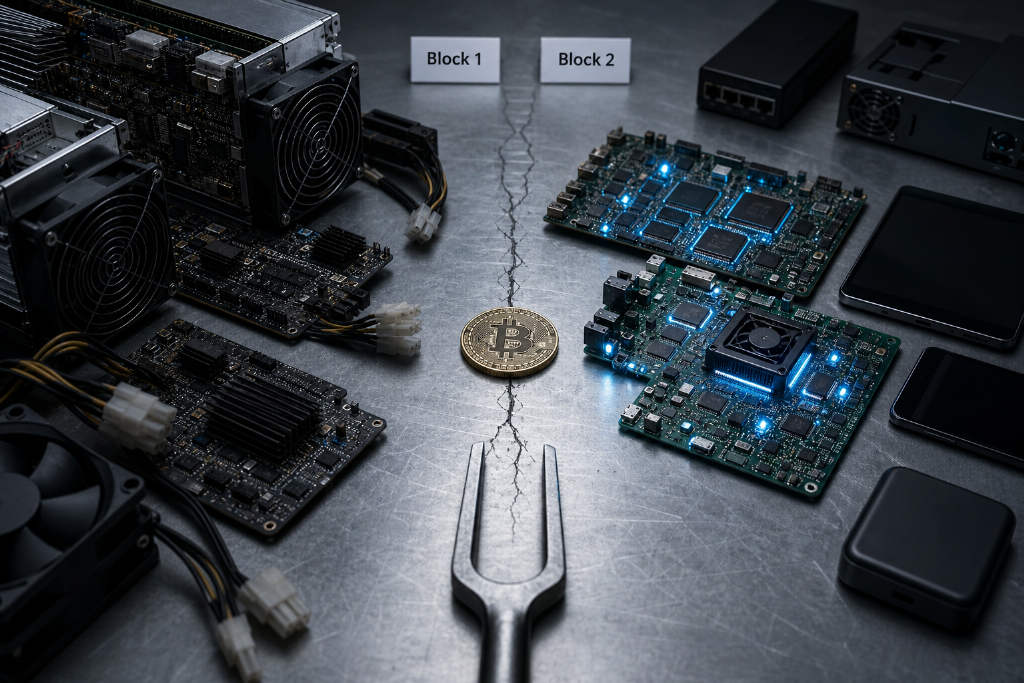
AI Finance2026-09-02 06:29:59Opinion piece argues crypto will be absorbed into AI finance rather than disappearA long-form opinion article published by ChainCatcher argues that crypto is on a path to being folded into AI finance, not pushed aside. The piece, written by Alan Walker from Silicon Valley and Jiayan Kea, frames AI and crypto as two systems built on the same mathematical asymmetry: one makes it cheap to generate claims that are hard to verify, while the other makes it cheap to generate claims that are easy to verify. On that basis, the article says an economy increasingly run by software agents will need a financial layer centered on low-cost verification, zero-trust-distance settlement, and fully computable rules. The article walks through eight sections covering proof-of-work, stablecoins, agent payments, onchain identity, and machine-native credit. It cites figures including Bitcoin mining difficulty at 127.48 trillion after an Aug. 8, 2026 adjustment, stablecoin supply at $320 billion as of May 2026, and x402 processing about 165 million agent transactions and $50 million in volume by April 2026. It also references ERC-8004, Mastercard’s proposed BVNK acquisition, Visa and OpenAI collaboration, and Hong Kong’s stablecoin licensing framework. Its central claim is that crypto’s long search for product-market fit may end with software agents rather than human users. In that scenario, the label “crypto” would fade as stablecoins, proof-of-work assets, public blockchains, wallets, and DeFi are recast as components of a broader AI finance stack.1070
BIP-1102026-08-31 22:07:36BIP-110 minority chain restarts with Blake2b mining and 300 KB blocksThe BIP-110 community restarted its minority fork chain over the weekend after the network had been stalled since Aug. 8. The chain has now produced more than 800 blocks, according to the report carried by Odaily and citing Bitcoin.com News. Blockchain developer Luke Dashjr changed the proof-of-work algorithm from SHA-256d to Blake2b and reduced block size to 300 KB as part of the restart. The fork split from Bitcoin at block height 961632 and later stalled. At height 961640, Silent Wave mined a block under the new Blake2b consensus rules, marking the chain’s return to block production. The project is expected to release new software on Sept. 1. The forked asset is not listed on any centralized exchange, and neither CoinGecko nor CoinMarketCap currently shows a token ticker for it. BIP-110 developer Chris Guida said the chain does not use centralized KYC exchanges and instead advocates obtaining and using bitcoin through the exchange of goods and services.900
Bitcoin2026-08-31 14:29:27BIP-110 Backers Plan Sept. 1 Launch for BLAKE2b Fork ChainDevelopers backing BIP-110 are planning to launch an independent proof-of-work chain on Sept. 1 that uses the BLAKE2b algorithm. The proposed chain would replace an earlier minority branch that produced only two blocks and failed to attract enough SHA-256 hashpower support. Under the hard fork plan, Bitcoin’s mining algorithm would shift from SHA-256d to BLAKE2b, which means existing Bitcoin mining machines would not be able to redirect hashpower to the new network directly. So far, no major exchange, wallet provider, or Lightning Network implementation has publicly committed to supporting the chain. Its launch still depends on whether the required technical conditions are met, according to Techub, citing crypto.news.970
BIP-1102026-08-15 18:56:12BIP-110 fork mined only four blocks in seven days, with supporters targeting a Blake2b switch in SeptemberThe BIP-110 branch split from the Bitcoin mainnet on Aug. 8 at block height 961632, but block production has barely moved since then. According to Odaily, citing Bitcoin.com News, the Roughnecks mining pool has produced only four blocks over the following seven days, leaving the chain stalled at height 961635. Supporters of the fork now plan, as early as September, to replace the proof-of-work hash function with Blake2b from SHA-256. That change would require updates to block header validation and upgrades across mining pools, wallets, explorers and indexing tools. The forked coin has not received exchange support and has no market price so far. More than 400,000 transfers are still waiting for confirmation, and the report said many of them were created unintentionally by users because the chain lacks replay protection. Tokens mined by Roughnecks cannot be used until they have received 100 confirmations.1520
Bitcoin2026-08-15 13:21:05Michael Saylor says Bitcoin is the monetary energy of the digital ageStrategy founder Michael Saylor described Bitcoin as the first monetary network designed in digital form, saying it combines computing, digital networks, and cryptography into a system that turns economic value into information that can move securely across global communications infrastructure. He said Bitcoin fully dematerializes monetary assets and replaces discretionary supply decisions with an open protocol. Saylor contrasted Bitcoin with gold, arguing that Bitcoin is harder to inflate, easier to integrate with software, and faster to transmit. He also said every participant in the network has an incentive to help protect it. In his view, proof of work ties Bitcoin to the physical world by using real energy to secure the ledger, raising the cost of rewriting history and drawing miners, energy providers, and investors into a shared defense structure. He also framed Bitcoin as an adaptive system made up of miners, nodes, developers, capital, and users, rather than static software. Saylor said its deliberately simple base layer focuses on maintaining a secure ledger for a scarce digital asset, while higher-layer applications handle complexity. He added that private keys give individuals permissionless control over economic energy, creating a new form of digital sovereignty based on mathematics instead of institutional verification.1100
Bitcoin2026-08-15 13:20:04Michael Saylor says Bitcoin monetizes digital scarcity and recasts value transferStrategy founder Michael Saylor said Bitcoin merges computing, digital networks and cryptography into what he described as the first natively digital monetary network in human history. In his view, the system dematerializes monetary assets, replaces discretionary supply control with an open protocol, and turns economic value into information that can move securely across global communications networks. He contrasted Bitcoin with gold, saying it is harder to inflate, easier to integrate with software and faster to transmit, while also giving every participant an incentive to help protect the network. Saylor also argued that proof of work ties Bitcoin to the physical world by using real energy to secure the ledger, raising the cost of rewriting history and drawing in miners, energy providers and investors to reinforce the system. He described Bitcoin as digital gold, but said "digital monetary energy" is a more accurate framing. He added that Bitcoin keeps its base layer deliberately simple, focusing on a secure ledger for scarce digital assets while leaving complexity to higher-layer applications that can support payments, credit and other financial services.1090
Bitcoin2026-08-13 02:35:52BIP-110 fails to activate after winning about 2.5% miner support, leaving a stalled minority chainBIP-110 failed to activate when its deadline arrived after receiving only about 2.5% of miner hashpower support, according to ChainCatcher. Nodes running the proposal split from the Bitcoin mainnet at block height 961632, and the minority chain later stopped producing blocks. The chain inherited Bitcoin’s mining difficulty while controlling less than 3% of network hashpower, which left block production stalled. Reactions quickly split across supporters and critics. Bitcoin Mechanic, speaking in a personal capacity as a backer of BIP-110, said the outcome showed Bitcoin had fallen into what he called "protocol capture," arguing that large mining pool operators coordinated to influence consensus rules and weaken node sovereignty. Cysic founder and CEO Leo Fan took the opposite view, saying Bitcoin’s difficulty adjustment mechanism protected the main chain and that BIP-110’s forced activation design was the central flaw. Separately, the anonymous owner of 1win said support for the proposal reached only 2.53%, well below the 55% activation threshold, while the main chain continues to run normally. Some supporters are now considering a hard fork to change the proof-of-work algorithm, and Bitcoin Mechanic said he will resume node operations after a Bitcoin Knots update.1350
Ethereum2026-08-12 15:16:07What Ethereum Might Look Like in 2026 if The Merge Never HappenedEthereum’s September 15, 2022 Merge cut the network’s energy use by about 99.95% and replaced proof-of-work with proof-of-stake, reshaping both ETH issuance and the chain’s security model. Nearly four years later, that decision is back in debate through a counterfactual lens: what if Ethereum had stayed on PoW through 2026 instead of moving to PoS? The discussion centers on a trade-off. On one side is the idea that Ethereum’s former GPU mining base could have evolved into one of the world’s largest distributed compute pools, potentially giving the network a stronger position in the AI era. Waterdrip Capital co-founder Jademont and crypto KOL 嗯哼 both argue that millions of GPUs once tied to ETH mining might have been reorganized into a decentralized AI cloud if the protocol and ecosystem had developed mechanisms for task scheduling, verification and revenue sharing. On the other side are the costs. Ebunker co-founder 0xTodd said Ethereum was producing roughly 13,000 ETH per day near the end of PoW, versus about 3,000 ETH after the switch, implying daily sell pressure of around $26 million versus $6 million at a $2,000 ETH price. The article also argues that staying on PoW would likely have meant more inflation, heavier miner selling, more constraints on scaling, and harder conversations around energy use, ESG and institutional adoption.1820